
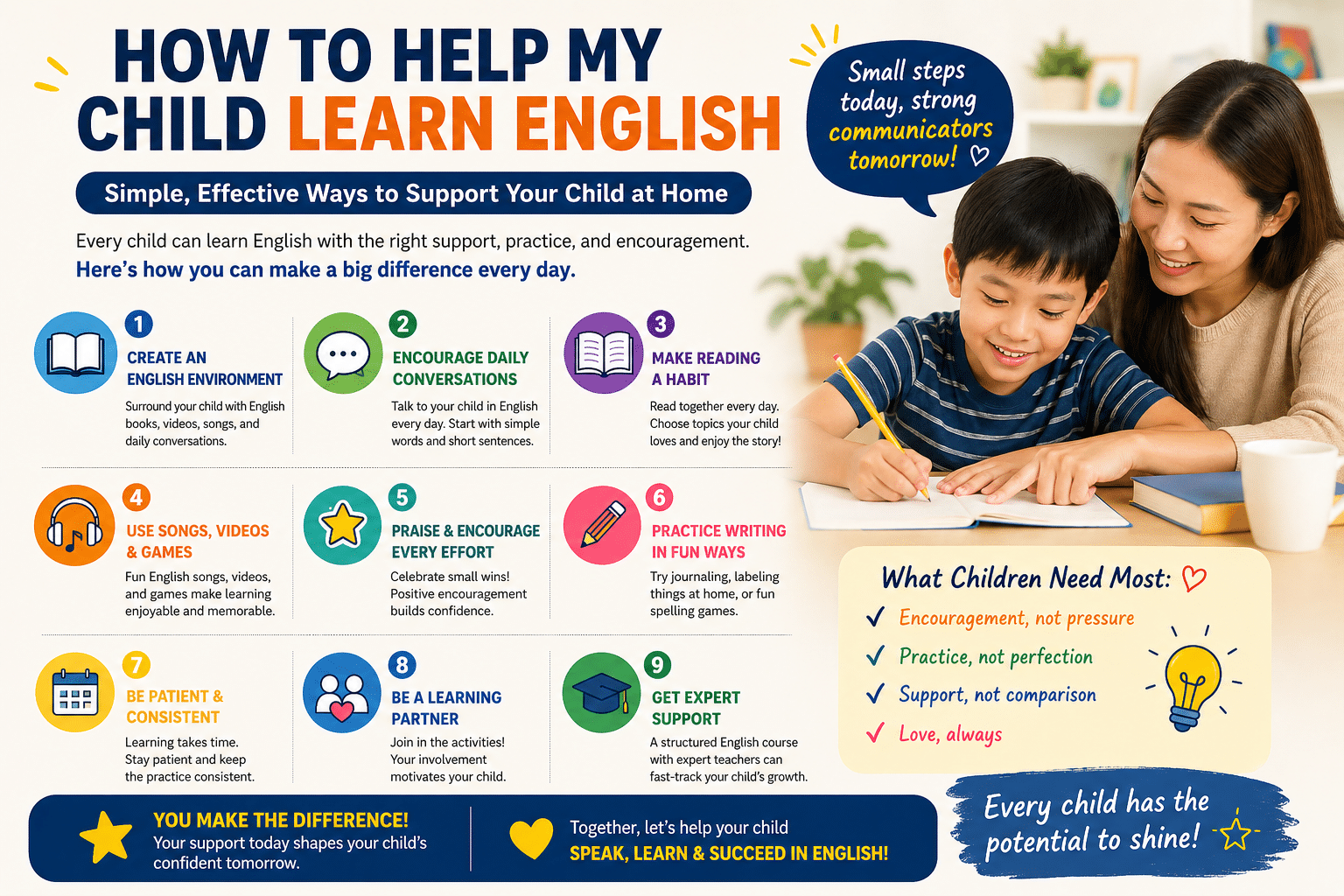
How to Help My Child Learn English Faster: 9 Positive Steps Parents Can Start Today
Many parents ask the same question: how to help my child learn English without making them feel stressed, bored, or pressured. The good news is that parents do not need perfect English to support their child. What children need most is encouragement, routine, practice, and the right teacher.
At English Pioneer Academy, children learn English with teachers from Australia ،UK ,Canada and America. This gives young learners clear pronunciation practice, natural conversation, and a friendly space to grow.
Parents also play a very important role. Cambridge English explains that parents can help children feel more confident and motivated by giving praise and opportunities to practice English, even if the parent does not speak English perfectly.
So, let’s look at simple steps parents can start using today.
Why Children Need Support at Home and in Class
Children learn best when English becomes part of their daily life. A class is important, but one or two lessons a week are not enough if the child never hears or uses English outside class.
That does not mean parents must create a strict school environment at home. In fact, the best English practice often feels light and natural.
A child can learn through:
- Songs.
- Stories.
- Games.
- Short conversations.
- Picture cards.
- Reading time.
- Daily routines.
- Praise and repetition.
The goal is not to make English perfect overnight. The goal is to make English familiar.
Learning English is easier with routine
Children feel safer when learning has a routine. For example, a parent may choose 10 to 15 minutes after dinner for English practice.
The British Council recommends short, regular English sessions for children and says young learners benefit from activities that are short and varied.
This is helpful because many children cannot focus for long periods. A short daily habit is often better than a long study session once a week.
Praise helps children feel motivated
Children are more likely to keep trying when they feel proud. Instead of only correcting mistakes, parents should notice effort.
Say:
How to Help My Child Learn English Effectively
“Great try.”
“You remembered that word.”
“I like how you said the full sentence.”
“Let’s try again together.”
“You’re improving.”
These words may seem small, but they can change how a child feels about English.
9 Simple Ways to Help Your Child Learn English
1. Read together every day
Reading is one of the best ways to build vocabulary and language awareness. Choose short, simple books with pictures. Let your child point, guess, ask questions, and repeat words.
Reading Rockets recommends taking turns reading aloud and gently correcting young readers when they make mistakes.
You can ask:
“What do you see?”
“Who is in the story?”
“What happened first?”
“What do you think will happen next?”
2. Use English in daily life
English should not only appear during homework. Use simple English during normal family moments.
Examples:
“Open the door.”
“Wash your hands.”
“Good morning.”
“Where is your bag?”
“Do you want milk?”
“Put on your shoes.”
Simple daily phrases help children connect English with real life.
3. Practice speaking without pressure
Some children understand English but do not want to speak. This is common. They may feel shy or afraid of mistakes.
Do not force long answers. Start small.
Parent: “What color is this?”
Child: “Blue.”
Parent: “Yes, it is blue. Can you say, ‘It is blue’?”
Little by little, the child grows.
4. Watch short English videos with purpose
Videos can help listening skills, but they should not replace active learning. Choose short educational videos, songs, or stories.
After watching, ask one or two questions:
“What animal did you see?”
“What color was the car?”
“Was the boy happy or sad?”
This turns screen time into learning time.
5. Label things around the house
Use sticky notes to label simple objects:
door
table
chair
bed
book
bag
window
cup
Children see the words every day, which helps memory.
6. Play word games
Children love games. Try simple activities like:
- I spy.
- Match the picture.
- Find something red.
- Say three animals.
- What starts with “b”?
- Memory cards.
- Sound games.
Games make learning feel less serious and more natural.
7. Build a small English routine
A useful routine could be:
| Time | Activity |
| 5 minutes | Review old words |
| 5 minutes | Read a short page |
| 5 minutes | Speak about a picture |
| 2 minutes | Praise and finish positively |
A routine should be easy to repeat. Do not make it too long.
8. Do not shame mistakes
Mistakes are part of learning. If a child says, “He go school,” do not say, “Wrong!” Instead, say, “Good try. We say, ‘He goes to school.’ Can you repeat it?”
Correction should feel safe, not scary.
9. Choose the right English course
Home support is powerful, but many children need a professional teacher too. A good teacher knows how to correct gently, explain clearly, and build confidence.
This is where English Pioneer Academy can help.
When Parents Should Consider Extra English Support
Some children improve with home practice. Others need more structured help.
Parents should consider extra support if the child:
- Avoids English homework.
- Cannot read simple words.
- Forgets vocabulary quickly.
- Feels afraid to speak.
- Cannot follow English instructions.
- Reads very slowly.
- Makes repeated spelling mistakes.
- Says, “I hate English.”
- Loses confidence at school.
Reading Rockets suggests that parents of struggling readers should find out whether the child needs extra help, speak with school staff, learn about options, and support the child at home.
Signs your child may need a teacher
A child may need teacher support when the same problem appears again and again. For example, if your child has practiced basic words many times but still cannot remember them, the issue may not be effort. The child may need a different method.
A trained teacher can find the weak point and create a better plan.
Why struggling does not mean failing
A child who struggles with English is not lazy or weak. Some children simply need more time, more repetition, or a more patient teaching style.
The right support can turn frustration into progress.
How English Pioneer Academy Helps Parents and Children
English Pioneer Academy helps children learn English in a clear, kind, and structured way. The academy focuses on real improvement, not pressure.
Australian and American teachers
Teachers from Australia and America help children hear natural English. This supports pronunciation, listening, and conversation.
Children can learn how English sounds in real use, not only in textbook sentences.
A child-friendly learning plan
English Pioneer Academy can support children with:
| Child’s Need | How the Academy Helps |
| Weak speaking | Conversation practice |
| Poor pronunciation | Teacher modeling and repetition |
| Reading difficulty | Guided reading and phonics |
| Low confidence | Positive correction |
| Weak vocabulary | Review through stories and games |
| Listening problems | Clear instructions and practice |
This gives each child a better chance to succeed.
FAQs About Helping Children Learn English
1. How can I help my child learn English if I do not speak English well?
You can still help by encouraging your child, playing English songs, reading simple books, using flashcards, and praising effort.
2. How long should my child study English each day?
Short daily practice is best. Around 10 to 15 minutes can be enough for young children when the activities are fun and focused.
3. Should I correct every mistake?
No. Correct gently and focus on the most important mistakes. Too much correction can make children afraid to speak.
4. What is the fastest way for a child to improve English?
A mix of regular speaking practice, reading, listening, vocabulary review, and expert teaching usually works best.
5. Why does my child understand English but not speak it?
Your child may lack confidence, vocabulary, or practice. Speaking needs a safe environment and regular conversation.
6. When should I join my child in an English course?
If your child avoids English, struggles often, or needs better pronunciation and speaking confidence, a structured course can help.
Conclusion
If you are asking how to help my child learn English, start with simple daily habits. Read together, speak gently, use English in daily life, praise effort, and make learning enjoyable.
For stronger progress, English Pioneer Academy offers expert English lessons for children with teachers from Australia and America. With the right mix of home support and professional teaching, your child can become more confident, more fluent, and more excited to learn English.

قد ترغب أيضا

IELTS vs. TOEFL: Which Test is Right for You?

 Arabic
  English