
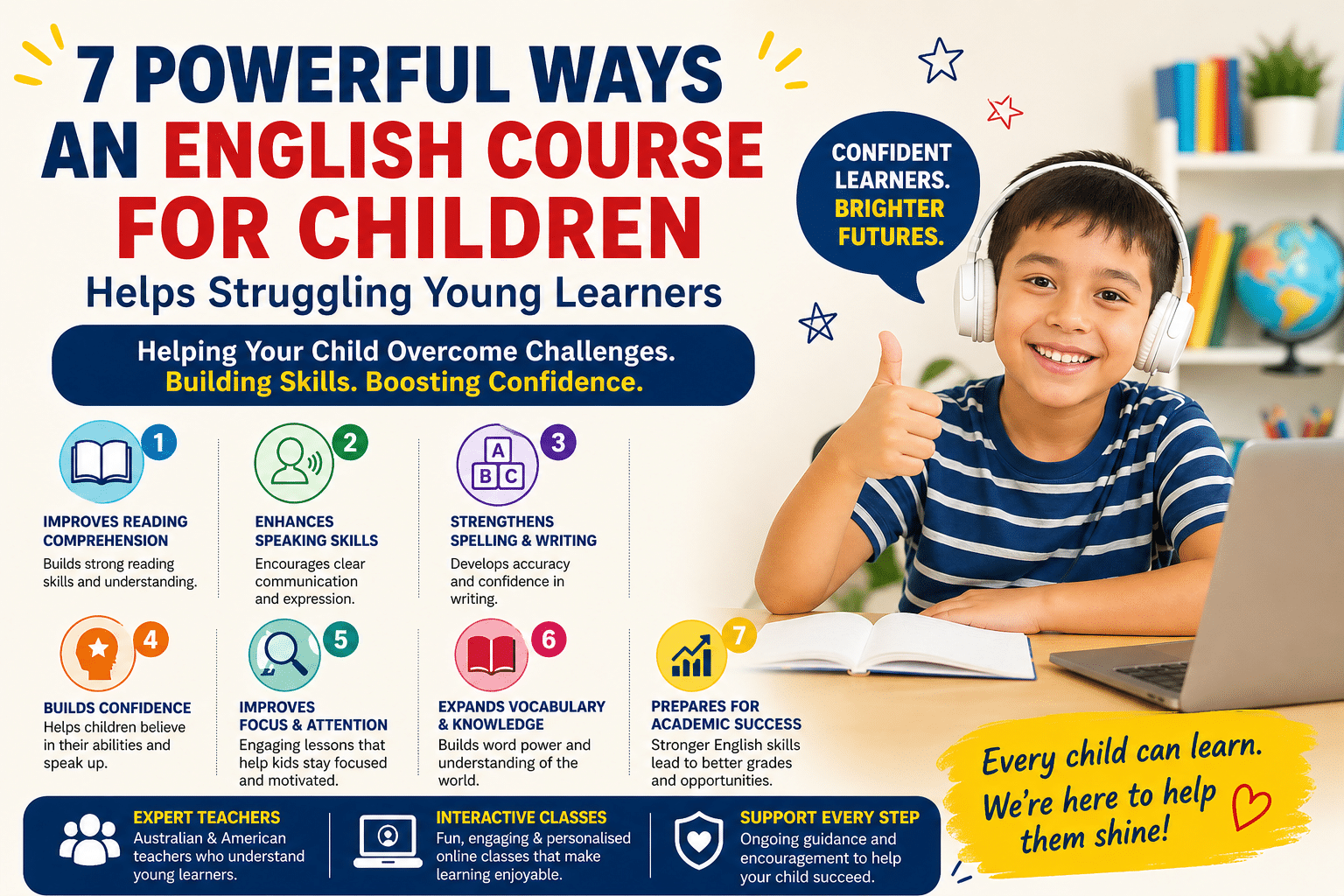
7 Powerful Ways an English course for children Helps Struggling Young Learners
Many parents worry when their 7-year-old child struggles with reading, spelling, speaking, or understanding English. They may ask, “Why is my child falling behind?” or “Why does my child avoid English homework?” The truth is simple: many children need a different teaching approach, more patience, and the right support system.
An English course for children at English Pioneer Academy is designed to help young learners build English skills in a calm, friendly, and structured way. With teachers from Australia and America, children hear natural English, learn correct pronunciation, and gain confidence through guided practice.
Learning difficulties can show up in different ways. Some children read slowly. Some forget words quickly. Some avoid speaking because they feel embarrassed. Others understand English when they hear it but cannot answer clearly. These signs do not mean a child is lazy or not smart. According to the National Institute of Child Health and Human Development, signs of learning disabilities can include difficulty learning new words, following directions, reading slowly, or organizing spoken and written language.
The good news is that children can improve when lessons are clear, warm, and consistent.
Why Many 7-Year-Olds Struggle with English Learning
The Importance of an English Course for Children
At around age 7, children are often expected to read more fluently, understand classroom instructions, spell common words, and express ideas in simple sentences. For some children, this stage feels easy. For others, it feels like climbing a mountain.
A child may struggle because of limited vocabulary, weak phonics skills, poor listening practice, low confidence, attention challenges, or previous negative learning experiences. Some children may also have reading-related difficulties such as dyslexia, which can affect word recognition, spelling, reading fluency, and writing. The International Dyslexia Association explains that dyslexia often affects reading accuracy, fluency, spelling, and writing, but the impact can differ from child to child.
Parents may notice that their child:
- Reads words very slowly.
- Guesses words instead of sounding them out.
- Forgets vocabulary after learning it.
- Avoids reading aloud.
- Mixes up similar letters or sounds.
- Needs a long time to finish English homework.
- Says, “I can’t do English,” or “English is too hard.”
These signs can be stressful, but they are also helpful clues. They show where support is needed.
Common signs parents should notice early
A child with English learning difficulties may not always say, “I need help.” Instead, they may cry during homework, refuse lessons, become angry, or act silly to avoid reading. Some children become quiet because they do not want others to notice their mistakes.
The Victorian Government’s education guidance lists signs such as trouble reading words accurately, limited vocabulary for age, difficulty remembering names for objects or actions, and frequent mistakes with letters.
Parents should not panic when they see one or two signs. However, if the same problem continues for months, it is wise to offer structured help.
Why learning difficulties do not mean low intelligence
Here’s the heart of the matter: learning difficulty is not the same as low intelligence. Many bright children struggle with reading, spelling, or language processing. They may understand stories when someone reads to them, but they may find it hard to read the same story alone.
That is why English Pioneer Academy focuses on the child’s learning style, not just the textbook. A child who struggles may need more visual support, sound practice, repetition, movement, conversation, and praise.
How English Pioneer Academy Supports Children Step by Step
English Pioneer Academy provides a supportive English learning environment for children who need patient, expert guidance. The academy’s teachers from Australia and America bring clear pronunciation, natural conversation, and international teaching methods into every lesson.
The goal is not only to help children “pass” English. The goal is to help them feel safe, capable, and proud of their progress.
Personal attention from Australian and American teachers
Children learn language best when they hear it often and use it actively. Teachers from Australia and America help students listen to natural English accents, understand everyday expressions, and speak more clearly.
This is especially helpful for children who feel nervous in school. Instead of only memorizing words, they practice English in real conversations. They learn how to say hello, answer questions, describe pictures, talk about family, and share opinions.
A teacher may ask:
“What do you see in the picture?”
“What color is the dog?”
“Can you tell me what happened first?”
“How do you feel today?”
These simple questions build speaking confidence step by step.
A gentle learning plan for each child
Every child is different. Some need help with phonics. Some need vocabulary building. Some need listening practice. Some need support with sentence structure.
English Pioneer Academy can help by identifying the child’s current level and creating a simple learning path. Lessons may include:
| Skill Area | How the Academy Helps |
| Reading | Phonics, sight words, short stories, reading games |
| Speaking | Guided conversation, role play, picture description |
| Listening | Teacher instructions, audio practice, story listening |
| Writing | Simple sentences, spelling support, short paragraphs |
| Confidence | Praise, correction with kindness, small wins |
This approach helps children grow without feeling rushed.
Building Strong Reading Foundations
Reading is often the biggest challenge for young English learners. A child may know the alphabet but still struggle to read words. This happens because reading is not only about knowing letters. Children must connect letters to sounds, blend sounds together, recognize common word patterns, and understand meaning.
Phonics, sounds, and word recognition
Phonics helps children understand the relationship between letters and sounds. For example, a child learns that c-a-t becomes “cat.” Later, they learn more complex sounds like sh, ch, th, oo, and ea.
For a struggling learner, phonics must be slow, clear, and repeated. English Pioneer Academy teachers can use games, flashcards, songs, short reading tasks, and sound drills to help children remember.
A child who once guessed words may begin to say:
“I know this sound.”
“I can read this word.”
“I want to try again.”
That small shift is powerful.
Helping children read without fear
Many children avoid reading because they fear mistakes. At English Pioneer Academy, mistakes are not treated as failure. They are treated as part of learning.
A teacher may gently say:
“Great try. Let’s look at the first sound again.”
“You were close. Try reading it slowly.”
“Well done for trying. Now let’s say it together.”
This calm correction helps children feel safe. Over time, they become more willing to read aloud.
Improving Speaking and Listening Skills
Some children understand written English better than spoken English. Others can repeat words but cannot answer questions naturally. Speaking and listening require regular practice, especially with teachers who use clear, natural English.
Real conversation with native-level teachers
Because English Pioneer Academy works with teachers from Australia and America, children are exposed to natural pronunciation and real sentence patterns. This helps them understand English beyond the classroom.
For example, instead of only learning, “This is a pencil,” children may learn:
“Can I have the pencil, please?”
“I use a pencil to write.”
“My pencil is blue.”
“I lost my pencil yesterday.”
This makes English practical and meaningful.
Fun speaking practice for shy children
Shy children often need extra encouragement. They may know the answer but feel afraid to speak. English Pioneer Academy can use friendly activities such as:
- Picture games.
- Storytelling.
- “Show and tell.”
- Role play.
- Question-and-answer games.
- Songs and chants.
- Short speaking challenges.
When children enjoy the lesson, they speak more freely.
Boosting Confidence in Children with Learning Difficulties
Confidence is a major part of learning. A child who believes “I am bad at English” may stop trying. But a child who believes “I can improve” becomes more open to learning.
English Pioneer Academy helps children build confidence through small, clear goals.
For example:
- Today, the child reads five words.
- Next week, the child reads ten words.
- Later, the child reads a short paragraph.
- Eventually, the child answers questions about the paragraph.
This steady progress shows the child that improvement is possible.
Praise, patience, and positive correction
Children with learning difficulties often hear too much criticism. They may hear, “Focus!” or “You already learned this!” or “Why did you forget again?” While parents usually mean well, these words can make children feel ashamed.
A better approach is patient correction.
Instead of saying, “That’s wrong,” a teacher can say, “Good try. Let’s fix it together.”
Instead of saying, “You forgot again,” a teacher can say, “This word needs more practice. We’ll review it.”
This creates a healthy learning atmosphere.
Turning mistakes into learning moments
Mistakes show what the child needs next. If a child reads ship as sip, the teacher knows the child needs help with the sh sound. If a child writes “He go school,” the teacher knows the child needs help with simple grammar.
This is why expert teaching matters. A trained teacher does not only mark mistakes. They understand them.
Why Parents Choose English Pioneer
Parents choose English Pioneer because they don’t want “another English class.”
They want a structured learning path that helps their child speak, understand, and use English with confidence—especially if the child needs extra support.
What makes English Pioneer different:
- A clear learning path (not random lessons): Your child moves step by step based on level and age—so progress is measurable, not guesswork.
- Native English teachers (UK/AUS/US): Children learn natural pronunciation and real communication from the start.
- Speaking-first learning: Kids don’t just memorize. They practice real conversation in a safe, encouraging way.
- Phonics + pronunciation support: The foundation that helps children read better and sound clearer over time.
- Full-skill support: Listening, speaking, reading, and writing—balanced for young learners.
- Parent clarity: Recorded lessons + progress updates so you can see what improved and what comes next.
For a 7-year-old, the right structure—and the right teacher—can change everything.
FAQs: English Learning Challenges in Children (Improved)
1) Is it normal for a 7-year-old to struggle with English?
Yes. Many children struggle at this age—especially if they have weak phonics, limited vocabulary, low confidence, or very little speaking practice. The good news is that with consistent, structured support, most children can improve steadily.
2) Does slow reading mean my child has a learning disability?
Not necessarily. Slow reading can happen for many reasons: limited practice, weak phonics foundations, attention challenges, or anxiety while reading. If concerns persist, it can be helpful to speak with your child’s school or a qualified specialist. This article is not a diagnosis.
3) How can English pioneer help my child improve?
We start with a level assessment, then build a plan around your child’s needs. Support may include:
- phonics and sound training
- confidence-based speaking practice
- reading and vocabulary building
- guided correction and simple, repeated practice
- clear progress tracking for parents
4) Why are native teachers helpful for children?
Native teachers help children get used to natural pronunciation, real sentence structures, and real listening from the beginning. That makes it easier for kids to speak clearly and feel confident in everyday communication.
5) What if my child is shy or afraid to speak English?
That’s common. Confidence grows through small wins: simple questions, guided speaking, games, pictures, and patient encouragement. The goal is to help the child feel safe to try—then improve step by step.
6) How long does it take to see progress?
It depends on your child’s starting level, consistency, and confidence. Many children improve confidence first, then show stronger speaking and reading skills over time. With regular sessions and practice, progress becomes clearer month by month.
Conclusion
A child who struggles with English doesn’t need pressure. They need structure, patience, and a plan that makes progress visible.
At English Pioneer, we help children move:
- from hesitation to speaking
- from unclear pronunciation to clearer sounds
- from “I can’t” to “I can try”
Tag:Course, English, for children



 English
  Arabic